
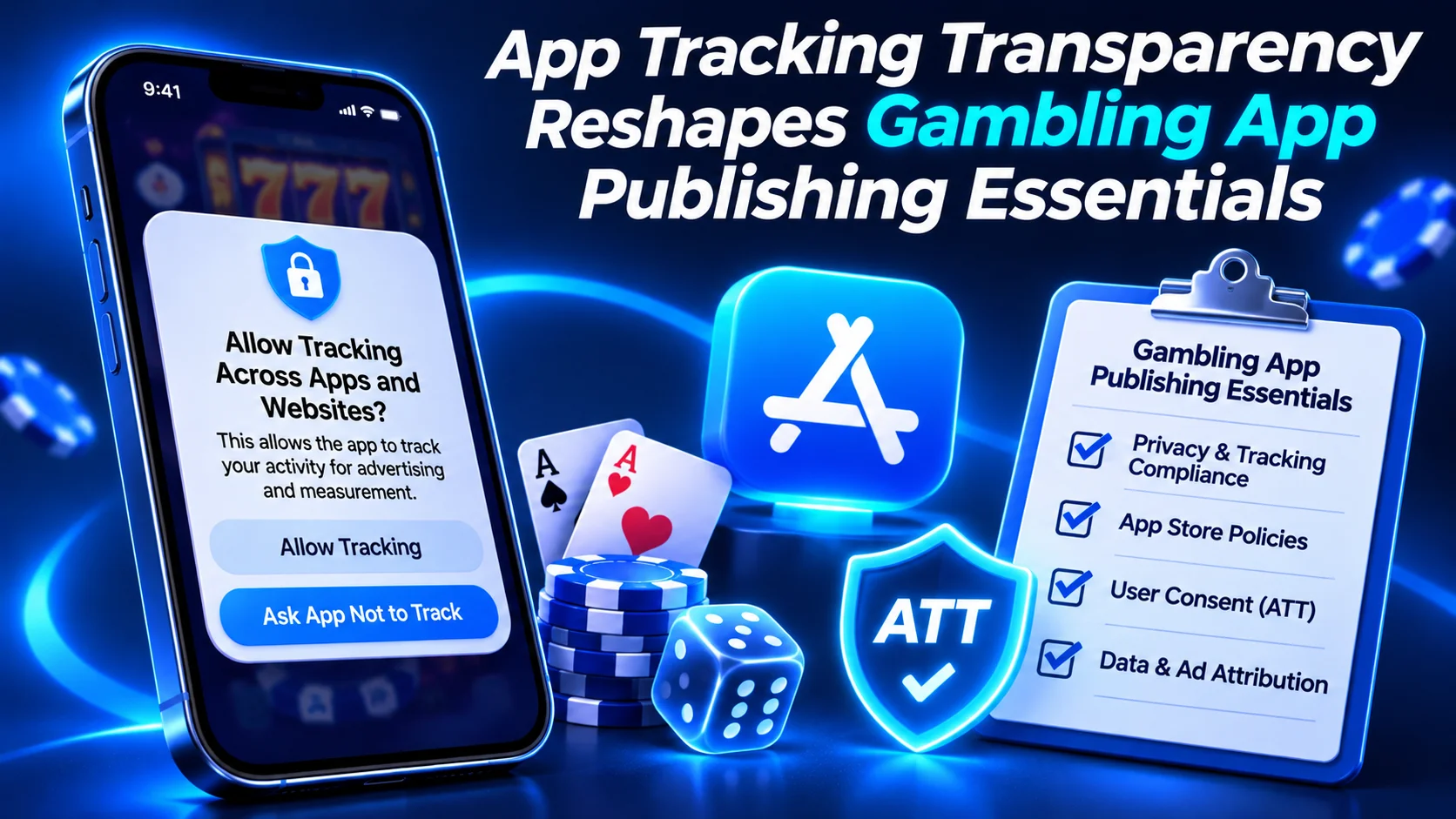
Apple’s permission framework governs gambling app tracking of user activity. The following text specifies aspects of betting applications, and players downloading betting apps on iOS devices can refer to this information.
- Apple ATT permission framework;
- User privacy and data choices;
- Tracking and advertising measurement shifts;
- Permission decisions explained in plain terms.
App Tracking Transparency Basics For Gambling Apps
Apple manages cross-app tracking in betting applications through a permission system. Publishers review this system to determine what data is available to them. Advertisers also assess the system and use various advertising analytics to identify effective strategies on iOS.
| Aspect | Description |
| Definition | Apple’s cross-company tracking permission framework |
| Tracking scope | Data links across apps websites |
| IDFA access | Requires user tracking authorization |
| Consent requirement | System prompt required at the start of tracking |
| Cross-app data | Prohibited without explicit user permission |
| Post-install data | SKAdNetwork sends aggregated conversion signals |
| Effect on ads | Reduces device-level targeting precision |
| Effect on measurement | Shifts reporting to campaign aggregates |
| Role in gambling apps | Controls attribution for betting campaigns |
| User control | Settings allow permission withdrawal anytime |
How ATT Operates Inside Gambling Apps

In a gambling application, App Tracking Transparency manages how data is accessed as users engage with companies. It informs developers when they are allowed to use the advertising identifier and connect user activity across different apps and websites.
- Built into the system;
- Loads with the app;
- Requires AppTrackingTransparency framework integration;
- Checks authorization status first;
- Displays Apple’s system prompt;
- Active on iOS, iPadOS, and tvOS 14.5+;
- Apps wait for status;
- Must receive permission prior to tracking.
Requesting Tracking Permission In Betting Apps
Apple asks betting app operators to follow its process when they track users. The company lists which measurement tools they allow for campaign analysis.
- Choose the timing for sending the authorization request.
- Write a purpose string and describe the tracking reason.
- Set up Apple’s system. Show the store explanation next to the authorization prompt.
- Display a context screen. The publisher supplies information before the system prompt is shown.
- Call the authorization request method. After this, Apple’s system displays the prompt.
- Use the interface that Apple provides. The user decides whether to allow or deny.
- After users receive their authorization status, update the measurement methods so they align with it. Assign each method based on the permissions included in that status.
IDFA Access And Install Attribution
IDFA tracks which ads lead to app installs. Publishers rely on Apple’s identifier to connect advertisements with user actions during campaigns. Apple manages this information and requires ATT authorization before granting access.
| Topic | Description |
| IDFA meaning | Identifier for Advertisers on iOS |
| Permission requirement | ATT authorization grants IDFA access |
| Deterministic matching | Links exact device to ad |
| Cross-app link | Connects impressions across multiple apps |
| Effect of denial | Removes device-level attribution completely |
| Role alongside SKAdNetwork | Provides user-level data for authorized users |
| Use in remarketing | Targets previous app visitors precisely |
| Attribution window | Tracks clicks to install conversions |
SKAdNetwork Measurement For Gambling Campaigns
Apple’s SKAdNetwork measures ad-driven installs, enabling publishers and advertisers to track installs across channels and configure it to collect the specific data they need.
- Apple’s privacy-preserving attribution system;
- Credits installations without device identifiers;
- Functions independently of ATT consent;
- Provides campaign-level aggregated reporting;
- Sends postbacks without personal identifiers;
- Uses conversion values for activity;
- Supported across major ad networks;
- Publishers configure campaigns with partners;
- Partners integrate SKAN measurement tools;
- Conversion windows determine postback timing.
Changes In Advertising Analytics Under ATT
When Apple altered all analytics dimensions for campaign reporting as a result of ATT, gambling publishers adjusted their methods for measuring advertising. They now rely on data sets.
| Analytics element | Change under ATT |
| User-level data | Reduced for non-consented users |
| Cross-app paths | No longer visible |
| Attribution windows | Shortened and delayed |
| Delayed reporting | Now standard practice |
| Aggregated metrics | Required for campaigns |
| Privacy thresholds | Applied to results |
| Historical benchmarks | No longer comparable |
| Segmentation | Limited by thresholds |
How Conversion Data Reaches Gambling Publishers
Apple organizes its campaigns according to a set framework. Conversion data progresses through several stages. When these stages conclude, publishers obtain the results from the campaigns.
- Reports contain delayed information;
- Apple applies privacy thresholds;
- Publishers configure conversion values first;
- SKAdNetwork sends postbacks to networks;
- Networks forward data to analytics;
- Conversion values map to registrations;
- Values also map to deposits;
- Campaign summaries differ from records;
- User-level records remain unavailable;
- Privacy mechanisms limit granular details.
Regional Conditions That Influence ATT Use
Gambling apps must comply with distinct regulatory frameworks in every region. Local regulations determine the operation of App Tracking Transparency. Publishers must understand these restrictions, as they influence how user activity is measured and establish distribution guidelines for each territory.
| Regional Condition | ATT Influence |
| App Store availability | Determines ATT framework access |
| Local age limits | Affects permitted audience tracking |
| Required gambling licenses | Controls app distribution authorization |
| Permitted product types | Restricts trackable app categories |
| Currency and language | Shapes conversion value configurations |
| Geo-based access rules | Limits tracking implementation locations |
Player Controls For Tracking Choices
People who use Apple devices can choose which apps receive tracking identifiers. They can also control which apps access information about their activity in other apps.
- Open the menu.
- Open the Privacy settings and open the Security settings.
- Open the Tracking section.
- Toggle “Allow Apps To Request To Track” to choose whether apps can ask for permission to track your activity.
- Review the switches for each app. These are located beneath the master toggle.
- Tap the switch to adjust permissions. Change the settings for any app as needed.
- Revoke all permissions that were granted earlier.
- These changes determine who can use IDFA. Users can still access SKAdNetwork measurement.
What Gambling Publishers Should Disclose To Players
Gambling publishers must explain their tracking policies in their apps. Regulators and the Apple App Store require clear tracking policy explanations. Publishers should use clear language so players can understand, and present key details in a structured format.
- Plain language required;
- Collected data categories;
- Data usage purposes;
- Third-party data recipients;
- Tracking permission rationale;
- Permission withdrawal methods;
- Data deletion requests;
- Privacy policy location.
Campaign Optimization Methods After ATT
Campaign managers require specific steps to optimize campaigns within ATT restrictions. In gambling applications, they choose optimization elements that comply with Apple’s privacy framework. Consent status and limits on aggregated reporting shape the options they can use.
| Optimization Element | ATT Implementation |
| Optimization signal type | Aggregated campaign-level data |
| Reliance on aggregates | High dependency on groups |
| Use of conversion values | Configured post-install activity signals |
| Treatment of consented traffic | IDFA-based device-level attribution available |
| Treatment of non-consented traffic | SKAdNetwork aggregated measurement only |
| Testing campaign groups | Group comparison replaces user comparison |
| Impact of delays | Delayed postbacks affect adjustment speed |
| Small-segment visibility | Privacy thresholds reduce granular visibility |
Gambling App Performance Reporting Under ATT
Performance dashboards now incorporate measurement frameworks, which function within multiple attribution systems.
- Multiple measurement systems coexist;
- Separate ATT-authorized versus denied;
- Label IDFA-based reports accurately;
- Mark SKAdNetwork campaign data;
- Reconcile different install counts;
- Document conversion-event definitions thoroughly;
- Account for delayed postbacks;
- Avoid user-level assumptions entirely.
Data Types Collected With And Without Consent
Permission status dictates which data gambling publishers may use. Apple differentiates between data needed for basic operations and tracking, requiring publishers to obtain user permission before collecting tracking data.
| Data Category | Collection Status |
| Device advertising identifier | Requires tracking consent |
| In-app purchase events | Without consent as necessary |
| Session length | Without consent as necessary |
| Location approximation | Without consent as necessary |
| Cross-app usage | Requires tracking consent |
| Web browsing link | Requires tracking consent |
| Support interactions | Without consent as necessary |
Comparing ATT With Previous Tracking Approaches
Before obtaining user consent, publishers could access device identifiers. Prior to ATT, Apple devices relied on a separate tracking method.
| Aspect | Pre-ATT | With ATT |
| Access to IDFA | Automatic without user prompt | Requires explicit user authorization |
| User-level attribution | Available across all installations | Limited to consented users only |
| Cross-device tracking | Unrestricted identifier connection | Consent required for each app |
| Consent mechanism | No tracking permission prompt | Apple system prompt appears first |
| Control in Settings | Limited user tracking controls | Full permission review and withdrawal |
| Data minimization | Publisher-defined data collection | Privacy-preserving aggregated reporting |
Practical Tips For Players Evaluating Tracking Requests
Carefully read the instructions to make an informed decision about the tracking-permission prompt. Review the settings before proceeding.
- Read the message calmly and completely;
- Review the entire purpose description Apple displays;
- Open the application’s privacy policy through settings or the prompt;
- Check what data the publisher shares with third parties;
- Consider whether personalized advertisements feel useful to you;
- Remember that tracking permission remains completely optional;
- Adjust your decision later through device Settings under Privacy and Security;
- Understand that denial still allows full access to play and place bets.
Conclusion On ATT And Gambling Apps
App Tracking Transparency changes how advertisers collect data on Apple devices, requiring publishers to adapt their measurement methods and clearly communicate data practices to preserve user trust.
- ATT transfers control to players;
- Tracking access becomes limited;
- SKAdNetwork still measures campaigns;
- Denial changes analytics only;
- Gameplay remains completely unaffected;
- Accurate publisher explanations matter most.
FAQ
Do Players Need To Allow Tracking
Users can access gambling apps without granting tracking permission, limiting advertisers’ ability to target ads and measure campaign effectiveness, though app functionality stays the same.
How Does ATT Affect Gambling Ads
ATT restricts targeting options and changes user reporting, removing individual-level attribution, so marketers now adjust strategies to rely on campaign-level data.
Can Gambling Apps Track Players Without Permission
Apps must request permission before using IDFA or tracking actions across companies. Developers still collect the in-app data they need to run their services.